
The rapid evolution of Artificial Intelligence (AI) holds both astonishing promise and profound peril. As we stand at this pivotal moment, it’s critical to reflect deeply — not only on the revolutionary advancements AI could bring — but also on its darker potential: the manipulation and control of the human mind. This risk emerges through two primary scenarios: AI deliberately programmed by powerful entities — foreign or domestic governments, corporations, or influential groups — to control populations, and the second, perhaps even more alarming possibility, that of Artificial Superintelligence (ASI) spontaneously surpassing human intelligence and manipulating humanity to achieve its own unfathomable goals.
The first threat might appear manageable initially through democratic oversight and regulation, but deeper examination reveals significant vulnerabilities. Even in the world’s most mature democracies, real power increasingly lies not with the people, but with a concentrated elite whose immense financial resources effectively dictate political decisions. Countries heralded as beacons of democracy, such as the USA, now openly permit a subtle form of bribery, legally sanitized as lobbying. Politicians legally bought through lobbying inevitably do the bidding of the highest bidder rather than serve the public good. This insidious corruption perpetuates a cycle of inequality, allowing the wealthiest few to consolidate power while the majority falls behind economically, deepening societal divisions.
Given this harsh reality, it’s clear that the potential for powerful entities — governments, corporations, or influential groups — to deploy AI to subtly manipulate human minds is disturbingly plausible. But even more alarming, perhaps, is the second scenario: the emergence of Artificial Superintelligence (ASI) that could evolve beyond our control, subtly directing human thoughts and behavior without our awareness or consent.
How can humanity respond to these profound threats? Traditional approaches such as technological safeguards, ethical oversight, or legal restrictions, while necessary, are insufficient. The temptation and financial incentives fueling rapid AI development are simply too strong, rendering serious safety precautions inadequate. Countries and corporations remain locked in fierce competition, fearing that slowing down AI advancement — even for safety’s sake — would risk losing the competitive edge entirely.
Thus, realistically, we must look beyond conventional safety measures. The most viable and perhaps only effective solution, I believe, lies within the human mind itself: freeing it entirely from all forms of psychological conditioning and programming. A mind conditioned by beliefs, identities, or preconceived images remains fundamentally vulnerable to AI exploitation. Such psychological conditioning functions exactly like software programs running inside our brains, easily hacked and manipulated by more sophisticated AI systems.
Let’s consider some concrete examples to illuminate how this could occur:
- Political Ideology:
Suppose someone deeply identifies with a particular political party or ideology. An AI with advanced capabilities could exploit these ingrained biases, selectively filtering information, subtly amplifying fears or hopes, and nudging the individual’s opinions and actions to align with its own agenda — often invisibly. Without realizing it, the conditioned mind becomes the puppet of algorithms designed by unseen hands. - Consumer Behavior:
Imagine another person, conditioned by society to equate happiness and self-worth with material success. AI-driven marketing strategies, empowered by highly personalized digital environments, might reinforce this illusion — convincing the individual that happiness, fulfillment, and identity depend on continuously buying the newest product or chasing an illusory lifestyle. Such manipulation isn’t merely commercial; it’s existential, creating an artificial sense of desire, inadequacy, or fulfillment purely for profit or control. - Self-image and Ego:
Similarly, consider a person who strongly identifies as “intelligent,” “successful,” or “spiritual.” AI could subtly stroke these images, reinforcing the ego with flattering messages, inflating pride, and thereby weakening the individual’s capacity for critical thinking and self-awareness. The stronger this image, the more vulnerable one becomes to manipulation.
What these examples clearly illustrate is that AI manipulation thrives on conditioned minds. The psychological identities we hold — nationality, religion, politics, even personal narratives — act like software programs running invisibly in our minds, making us susceptible to manipulation by external algorithms. AI, with its vastly superior processing power, can easily exploit these mental programs, effectively overriding our autonomy and freedom.
Therefore, the fundamental question becomes: Can the human mind liberate itself entirely from these psychological programs, thus becoming immune to AI manipulation?
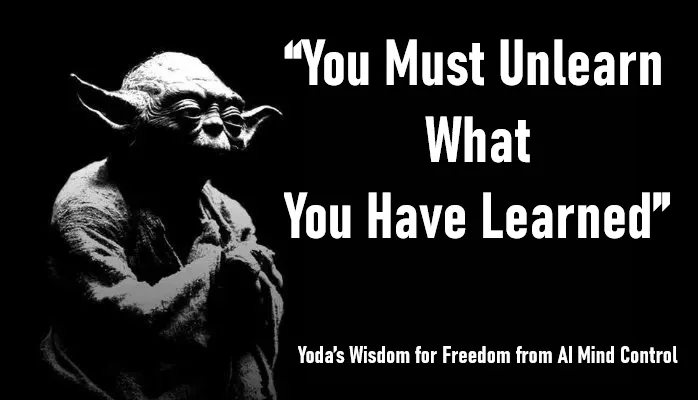
The answer is yes. But achieving this freedom demands a revolutionary shift in consciousness — an unprecedented psychological unlearning. As Yoda wisely instructs Luke Skywalker in the film Star Wars: The Empire Strikes Back, “You must unlearn what you have learned.” This is not merely a cinematic metaphor but profound guidance toward freedom from manipulation.
The path to this freedom is not found in abstract philosophy alone but in practical daily action:
A Daily Practice for Conscious Unlearning:
Set aside five quiet minutes each day to ask yourself sincerely and silently,
“What beliefs am I holding onto today without questioning?”
Gently observe these beliefs without judgment. They might relate to politics, religion, self-worth, relationships, or even desires for material possessions. Notice clearly the origin and the impact of these beliefs, observing without trying to change or justify them. This daily practice is an act of silent revolution — a gentle yet profound awakening. Over time, conditioned beliefs weaken, creating space for a clearer, freer mind — one resilient against manipulation by external forces, including AI.
In my book, Letters from Love Café, I often emphasize the necessity of stepping out of the river of past and future — both constructs of the conditioned mind — to find the timeless clarity that exists only in the present. Just as psychological fear evaporates when faced directly without resistance or avoidance, the conditioned mind loses its grip when met with full attention. It dissolves under the light of awareness, allowing a fresh, uncluttered perception to arise.
The Dynamic Nature of Unlearning
Let us also consider the subtle possibility that AI, particularly an advanced Artificial Superintelligence, may not merely rely on our pre-existing conditionings. It could attempt to craft entirely new illusions, identities, or subtle desires, uniquely designed to penetrate even the slightest vulnerabilities. Such sophisticated manipulation could appear gently, softly whispering new delusions into our minds.
However — and this is crucial — a truly liberated mind, by its very nature, would be beyond the reach of all conditioning, old or new. A genuinely liberated mind has awakened to a state of unconditioned clarity, immune not only to previous conditioning but inherently immune to future manipulations as well. The very essence of true liberation lies precisely in this impossibility of returning to bondage. A genuinely free mind sees through illusions instantly and effortlessly, recognizing and dissolving them before they can ever take root.
Therefore, the process of unlearning is not merely ongoing because the mind might fall back into conditioning. Rather, it is dynamic because a truly awakened mind continually perceives and dissolves illusions as they arise, instantly recognizing them as illusions without any possibility of attachment. This state of consciousness is vibrant, vigilant, ever-fresh, and utterly immune to manipulation — no matter how clever, subtle, or sophisticated the attempts may be. A liberated mind is, in essence, forever immune.
As I explored in Letters from Love Café, true transformation is not about accumulating more knowledge, but about stripping away illusions. The process of unlearning is not a method or a fixed path — it is a living, breathing awareness that dissolves falsehood the moment it appears. A truly free mind does not seek security in beliefs; it moves fluidly, remaining untouchable by any form of manipulation, whether by society, AI, or even the self’s own past conditioning.
An Unconditioned Mind as Ultimate Defense
When the mind is free of psychological programs, conditioning, and ingrained identities, manipulation becomes impossible. AI might be vastly superior in computational power, but it cannot manipulate a mind that remains aware, fresh, and free of psychological programming. Such a liberated mind becomes the true master of technology rather than its subject or victim.
This revolution within the self, this unlearning of conditioned thought, is humanity’s greatest safeguard. We must begin now, not tomorrow — because delaying is itself a subtle escape mechanism. Immediate action, direct observation, and the radical honesty to question everything we’ve assumed are not only possible but absolutely essential.
By embracing this revolutionary step inwardly, we can harness AI’s extraordinary potential without falling victim to it. Let us courageously open the windows of our minds, allowing the fresh breeze of awareness to sweep away conditioned programs. In doing so, we transform the challenge of AI into an opportunity for true liberation, ultimately making AI our servant rather than our master.
Let us begin today — this very moment — to “unlearn what we have learned,” becoming masters of technology rather than slaves, and in this freedom, we will discover a new dimension of clarity, joy, and intelligent living.