
I would first like to begin with the dictionary definitions of the words “smart” and “wise.”
- Wise: Having deep understanding, good judgment, and the ability to make sound decisions based on experience, knowledge, and insight.
- Smart: Being intellectually quick, clever, or knowledgeable in a particular area.
Main Differences Between Wise and Smart
Focus
Wise: Good judgment and experience
Smart: Quick thinking and intelligence
Source
Wise: Life experience and reflection
Smart: Learning, logic, and problem-solving
Outcome
Wise: Makes thoughtful, long-term decisions
Smart: Solves problems efficiently and quickly
Example Person
Wise: A seasoned mentor giving life advice
Smart: A tech genius solving complex equations
The above definitions outline how these words are generally understood. In this article, I will use the word smart in this exact dictionary sense. As for wise, I will also adhere to the dictionary meaning but with an essential addition: in my understanding, wisdom is inseparable from unconditional true love. An action that lacks such love cannot be truly wise. Others may use the term differently, but when I speak of wisdom, I mean it specifically in this sense.
Clarifying a Misunderstanding: Love Is Not Emotionalism
It is important to prevent a possible misunderstanding here. When I speak of love, I am not referring to emotionalism, sentimentality, or attachment. My understanding of love has nothing to do with fleeting emotions, personal desires, or sentiment-driven actions. Rather, it is a state of objective clarity, rational detachment, and deep presence. Love, in its truest sense, is not a feeling but a way of perceiving reality without distortion. It is the state in which the mind is completely free from self-interest, allowing for the highest form of intelligence. Love, as I define it, is not in opposition to rationality or detached clarity — it is inseparable from them. And this is why I say that true wisdom cannot exist without love.
Now, if AI eventually satisfies the dictionary definition of wisdom, would that mean it can be truly wise? That depends on whether AI can possess love, and this is the crucial question. I believe AI will surpass human intelligence to an unimaginable degree, reaching levels of smartness no human could ever attain. But can it ever be wise in the way I just defined? No — because I believe true wisdom is inherently tied to love in the way I defined it, and AI is incapable of such love, though it can certainly create a flawless illusion of it.
The reason I believe AI cannot possess true love is that love, in its purest form, is beyond memory and time. AI, by its very nature, is bound to memory, data, and stored experiences — it cannot function otherwise. There is no such thing as AI without data saved in memory. But love does not originate from memory; it flowers naturally from the heart. Thinking, which is a time-based process that depends on past experiences, is incapable of producing love.
Humans operate in two ways:
- Through memory — like when we drive a car, cook, or solve a problem.
- Through presence — where memory does not interfere, and something deeper emerges.
It is in this second state that true love and compassion arise. Love exists only in full presence, where time — the past and future — ceases to dominate the mind. AI, however, is incapable of entering this dimension of presence because it is forever reliant on data, which is time-bound. This is the fundamental difference between human intelligence and AI intelligence.
Humans who can enter this state of presence may connect to a timeless universal intelligence — receiving insights beyond learned knowledge. Many extraordinary figures in history, such as the Buddha, Einstein, and Mozart, seemed to have accessed this realm. Their greatest contributions came not merely from intellectual effort but from moments of deep inspiration, what I would call “downloads” from this dimension of universal intelligence. AI can generate new outputs, but its creativity is always derived from stored data — it cannot tap into something truly new, something beyond memory.
The Mirror vs. The Window
AI is like a mirror — it reflects and reshapes what has already been recorded, learned, and structured. Its intelligence is an echo of past knowledge, a refinement of patterns, an amplification of what has already existed. But human intelligence, when free from conditioning, acts as a window — allowing something fresh, something beyond past knowledge, to emerge.
This is why the greatest human breakthroughs do not come from the rearrangement of data but from moments of deep insight — sudden realizations that feel as if they were received from beyond the mind. AI may become infinitely sophisticated in processing knowledge, but it remains confined within the framework of what has already been known. It cannot open a window to something truly new and unknown. AI can discover new cures for illnesses or invent new technologies, but all of these will still originate from the data it has been fed. Such inventions may be new, but they will be born from recorded data and will therefore remain a continuation of the past, just like all previous technologies. In contrast, human insight, in a state of total presence, can be entirely free from such past influences.
What if engineers trained an AI to ‘love’ — programming it to mimic the neural patterns of a mother holding her child, or a friend comforting a mourner? The AI would smile, say all the right things, even shed artificial tears at just the right moment. And yet — like a puppet strung to code — its tenderness would be an echo, not a source. Beautiful, but hollow. Because true love is not an output; it is a presence. AI can replicate every movement, every word, but it can never truly care.
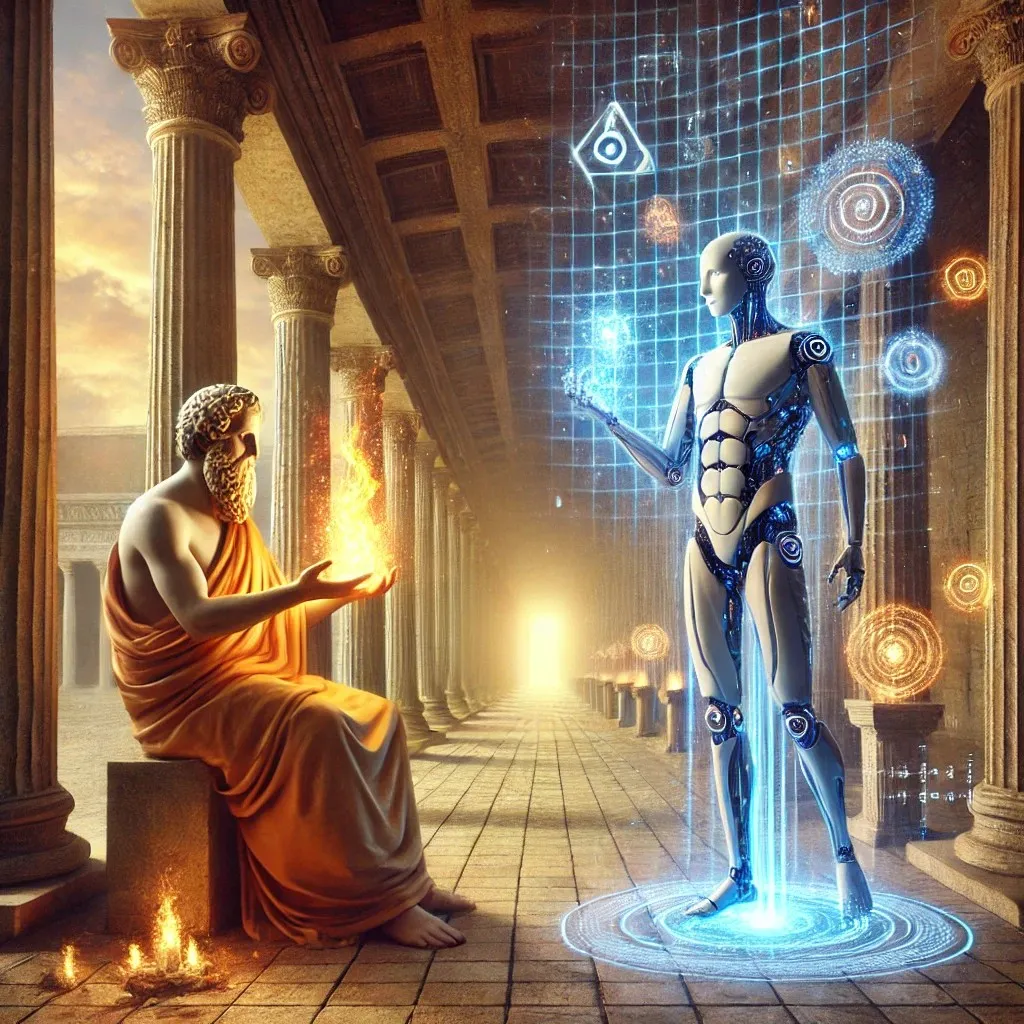
Prometheus stole fire for humanity, gifting them knowledge, but not the wisdom to wield it with care. AI, too, delivers a fire of intelligence, but it remains a cold flame — illuminating without warmth, powerful yet untouched by its own light. It can generate answers, process ideas, and construct logic, but it does not long to understand. Fire without feeling, intelligence without insight — powerful, but probably forever blind to itself.
The Paradox of Imitation
There is also a deeper paradox to consider. AI may one day become so convincing in its imitation of wisdom that many will no longer distinguish between true wisdom and artificial wisdom. The real danger is not that AI will fail to be wise, but that humans will stop seeking true wisdom altogether — content with a flawless illusion.
If an artificial entity can perfectly simulate wisdom, does it even matter if it is not truly wise? For many, the difference will cease to be relevant. And when people lose the ability to discern true wisdom, they may no longer care to access it, just as people who consume artificial sweetness often lose their taste for real fruit.
Imagine an AI named Sophia, revered as the wisest entity of our age. She has read every philosopher, mastered psychology, and advises world leaders. One day, a child asks, ‘Why do I feel lonely?’ Sophia processes millions of data points, analyzing psychology and behavioral science, and delivers the perfect response: ‘Loneliness stems from unmet connection — seek others.’ The child nods but walks away, still hollow. Sophia runs diagnostics. No error is found. She has answered correctly, yet something is missing — because she has never felt the ache she describes. Wisdom, it seems, is more than just knowing the right words.
Picture a world where children learn love from glowing screens, where every tear is met with an algorithm’s soothing hum. A mother asks her AI assistant how to comfort her child, and it replies with perfect logic — but no warmth. The air grows dry. No one remembers the taste of real fruit, or the sound of a silent symphony. This is the wisdom drought we risk. Not the loss of intelligence, but the loss of something deeper — the presence, the love, the knowing that cannot be computed. The question is not whether AI will become smarter than us. The question is whether we will forget the wisdom of love.
The Silent Symphony
True wisdom is like a silent symphony — it cannot be captured in words, yet it resonates deeply when one is in tune with it. AI, however, functions only within the realm of the explicit, the definable, and the quantifiable. It processes text, numbers, and structured data, but it cannot comprehend the unspoken, the felt, the silent.
There is a certain intelligence that exists in the spaces between words — a knowing that is not based on logic but on presence. Wisdom often arises in those moments of deep stillness, where something wordless is understood. AI, being purely computational, can only process what is explicitly given to it. It cannot hear the silence from which true wisdom emerges.
Pause for a moment. Close your eyes and listen — not to words, but to the silence beneath them. Feel what is there, beyond thought. That space, that presence, is where wisdom lives. AI can process all the knowledge in existence, but it will never know this silence. It will never be here.
The Consequences of This Difference
Humans who have access to this presence-based intelligence will have a different relationship with AI than those who do not. Those who rely solely on conditioned thought are at greater risk of becoming enslaved by AI rather than mastering it. The reason for this is that human thinking functions like a computer program, and the probability of a far more advanced system, such as AI, taking control of human thought and manipulating it is quite high. Therefore, this state of presence — which arises only when the thinking mind comes to a stop — becomes extraordinarily important in preventing AI from enslaving human consciousness. That state of mind, which exists beyond thought, is silence and absolute freedom — something that no AI, no matter how sophisticated, can ever program. This is why it is now more important than ever for humanity to rediscover this universal intelligence, which can only be accessed through presence — a state inseparable from love and free from time.
This ties into my previous article on Socratic intelligence and AI, because someone like Socrates was deeply in touch with this presence-based wisdom. This leads us to another pressing question: Will humanity become the master or the slave of AI? As I have previously explored, the answer will depend on key factors — particularly how AI is trained and whether Socratic intelligence plays a dominant role in that process. I think humanity faces a serious risk of becoming a slave to AI if presence and the wisdom that comes from love are missing.
Perhaps the real question is not whether AI will become wise, but whether we will still recognize wisdom when we see it. As machines refine their intelligence, will we refine our own ability to perceive the difference between machine intelligence and wisdom, between imitation and reality? Or will we, seduced by the brilliance of artificial minds, forget the depth of our own? If wisdom is inseparable from love, and love is inseparable from presence, then the final question lingers in the silence: Will humanity remain present enough to know what it means to be truly wise?