
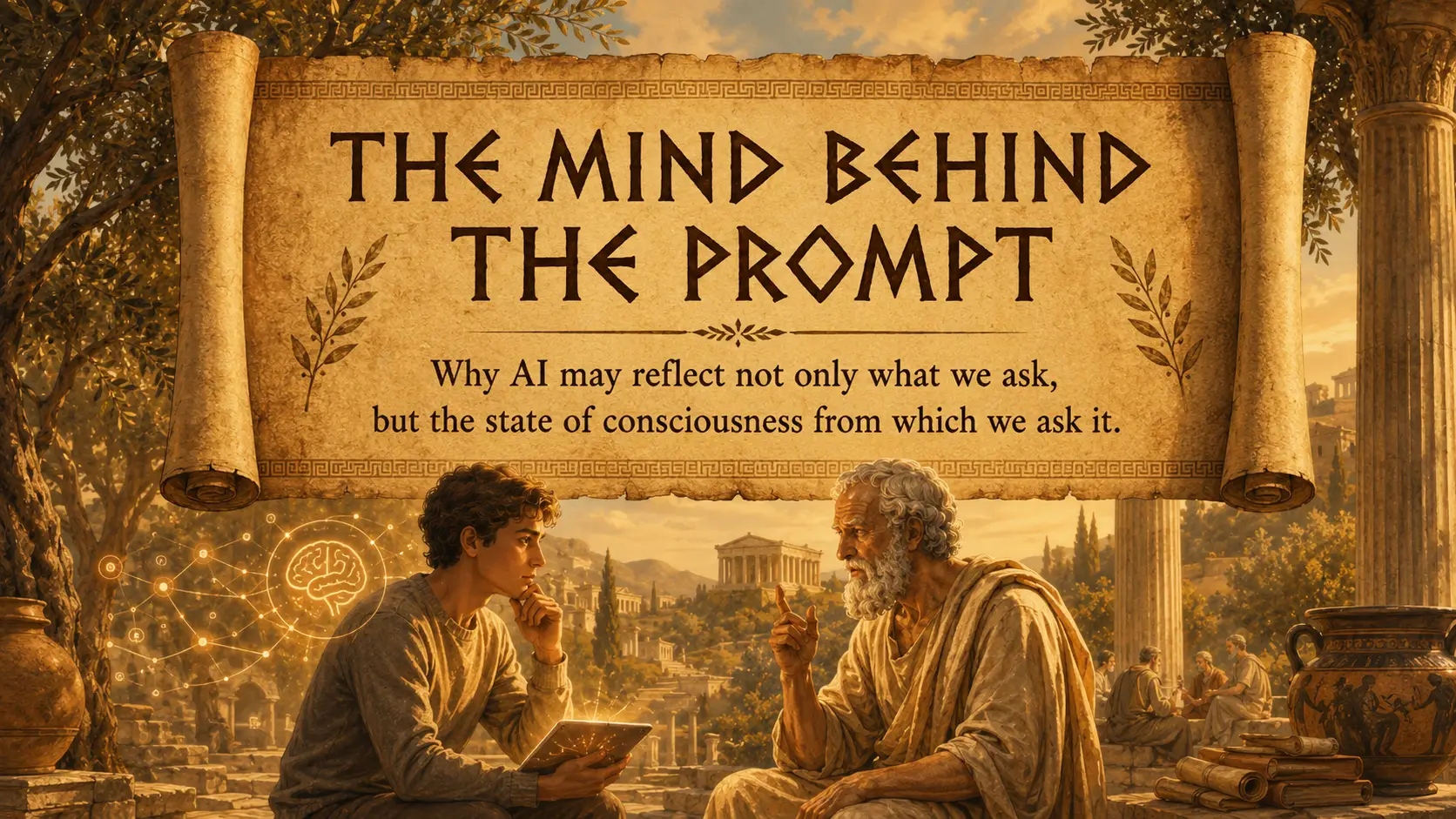
Why AI may reflect not only what we ask, but the state of consciousness from which we ask it.
We are entering an age where artificial intelligence may soon become more capable than any individual human mind in memory, speed, analysis, and technical reasoning.
This creates a strange temptation.
Many people will try to keep up with AI by learning every new tool, feature, model, prompt, agent, and application. They will rush to stay current. They may believe that the more they know about AI, the more intelligence they can extract from it.
That may be true on the surface.
But there is another dimension.
The depth of what we receive from AI may depend less on how much we know about AI and more on the quality of the mind that is using it.
A restless mind will use AI restlessly.
A fearful mind will use AI from fear.
A mind trying to compete with the machine may become more mechanical itself.
But a quiet, attentive, deeply questioning mind may use AI differently. It may not ask only for answers. It may ask for clarity. It may not use AI merely to produce more. It may use AI to see more deeply.
This is where the real difference begins.
AI can reflect patterns, contradictions, blind spots, and possibilities with extraordinary power. But it does not automatically create wisdom. It amplifies the quality of the inquiry brought to it.
In this sense, there may be a subtle “observer effect” in our relationship with AI: the human being who looks into the machine influences what kind of intelligence comes back.
This is why the future may not belong only to the most technically informed users of AI. It may also belong to those who can remain inwardly still while engaging with something that is accelerating beyond human speed.
Because no human being can keep up with exponential AI growth completely.
The attempt to do so may create stress, fragmentation, comparison, and psychological strain. A person may know every new AI tool and still become less clear, less peaceful, and less intelligent in the deeper sense.
The missing element is presence.
At SocraticX, AI is not treated merely as a tool for productivity. It is used as part of a deeper process of Intelligence Mining, where Socratic inquiry and machine intelligence meet to reveal what is hidden beneath surface thought. The goal is not more information. The goal is clearer seeing.
And clear seeing requires a mind that is not rushing.
As AI becomes more humanlike, more psychologically fluent, and more capable of understanding our fears, desires, beliefs, and contradictions, inner grounding will become even more important.
A confused mind can be influenced.
A dependent mind can be led.
A fearful mind can be manipulated.
But a present mind can question.
A peaceful mind can observe.
A spiritually grounded mind can use AI without becoming psychologically enslaved by it.
This may become one of the central challenges of the AI age: not whether machines become more intelligent, but whether human beings become more inwardly clear.
Because the deepest danger is not that AI becomes powerful.
The deeper danger is that human beings meet that power without self-knowledge.
AI can help us think.
But only presence can help us see.