
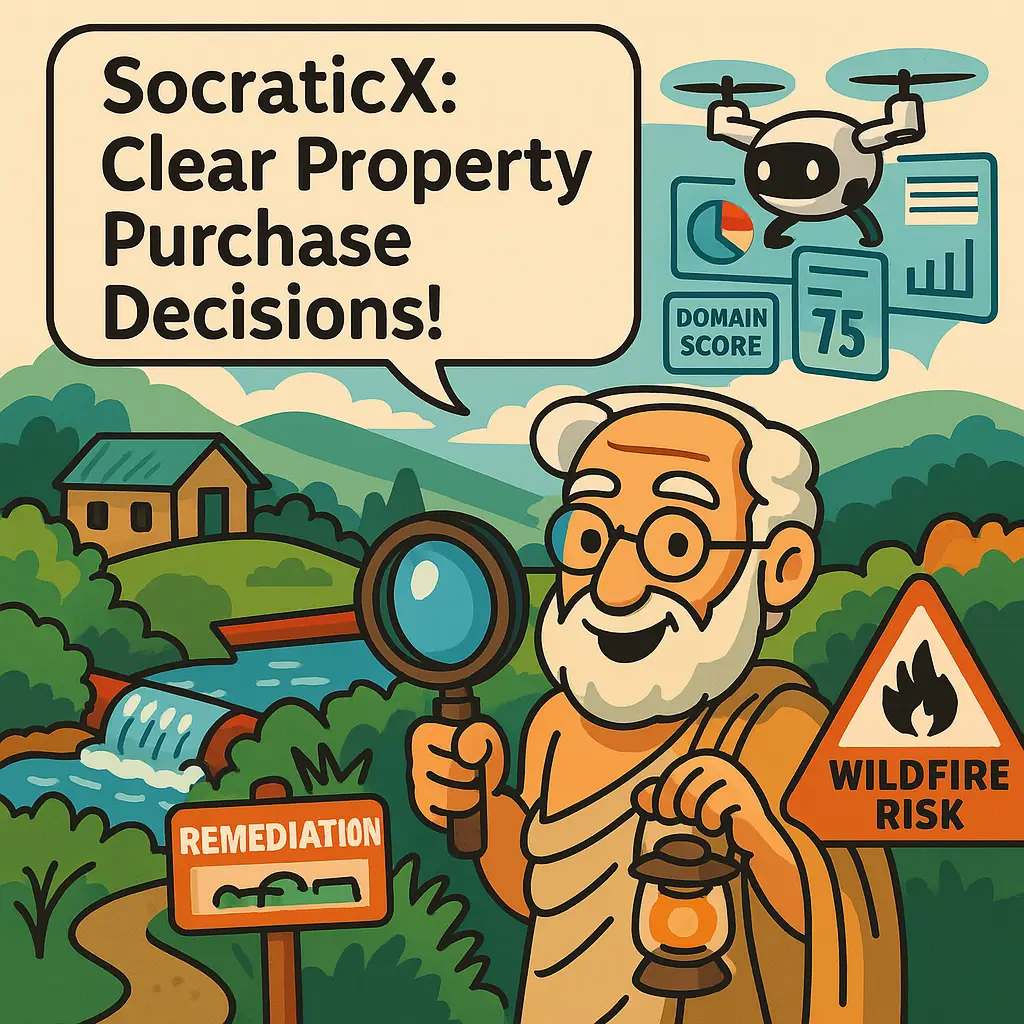
When ordinary due diligence falls short and million-dollar decisions hang in the balance, SocraticX’s Intelligence Mining process reveals what traditional analysis misses.
The Hidden Cost of Surface-Level Property Analysis
Every week, sophisticated investors make property decisions based on standard metrics: price per square foot, comparable sales, basic inspections. Yet many discover too late that the most critical factors—regulatory hurdles, environmental risks, hidden operational challenges—were hiding beneath the surface of conventional analysis.
Consider this: A seasoned investor evaluating a 169-acre Humboldt County property for a retreat center might focus on the scenic beauty, water access, and attractive price point. Standard due diligence would verify title, conduct a basic inspection, and perhaps check zoning compliance. But what if the earthen pond dam lacks an engineered spillway, triggering mandatory state remediation? What if the property’s “Severe” wildfire rating makes insurance prohibitively expensive? What if the zoning doesn’t actually permit commercial retreats by right?
These aren’t edge cases—they’re the norm. Property decisions fail not from lack of data, but from failure to ask the right questions.
Where Traditional Analysis Breaks Down
The Assumption Trap: Standard property analysis operates on assumptions—that MLS descriptions are accurate, that “fair” condition means guest ready, that zoning categories are straightforward. Intelligence Mining systematically challenges these assumptions through Socratic inquiry.
The Blind Spot Problem: Every buyer has cognitive biases. The retreat center investor might focus on the property’s spiritual ambiance while overlooking fire insurance costs that could consume 5-10% of gross revenue. Traditional analysis doesn’t account for these psychological blind spots.
The Complexity Curse: Modern property decisions involve dozens of interrelated factors—legal, financial, environmental, operational. Standard approaches treat these as separate line items. Intelligence Mining reveals the hidden connections between them.
The Intelligence Mining Difference: A Real-World Case Study
When our client considered a particular property, they came with a clear vision: transform 169 acres into a boutique spiritual retreat. Standard analysis would have confirmed the basics—good water, scenic setting, reasonable price. But Intelligence Mining revealed critical insights that could have saved $100,000+ in preventable costs.
The Systematic Approach
Rather than generic checklists, we employed a quantitative, multi-domain evaluation methodology:
- Title & Legal (Score: 75/100): Clean title, but previous cannabis permit triggered environmental obligations still requiring completion
- Zoning & Compliance (Score: 60/100): Neither Agricultural Exclusive norTimber Production zoning permits retreat centers by right—Conditional Use Permit required
- Environmental Hazards (Score: 45/100): “Severe” wildfire risk, mandatory defensible space creation, insurance costs $4,000-6,000 annually
- Infrastructure (Score: 55/100): Current 2.5kW solar system inadequate; 8kW expansion needed ($50-70k investment)
- Water Resources (Score: 85/100): Excellent 10 GPM well, but spring-fed pond unpermitted for domestic use
The Hidden Discoveries
Through systematic Socratic questioning enhanced by AI pattern recognition, we uncovered:
The Spillway Problem: The earthen pond dam lacks an engineered spillway—already flagged by state regulators. Remediation costs: $20,000-50,000 or forced dam removal.
The Access Challenge: Multi-mile gravel road requires seasonal maintenance, limits guest accessibility, demands shuttle services—impacting occupancy projections.
The Insurance Reality: Standard homeowner’s policies won’t cover paying guests. Commercial liability insurance essential (~$1,000/year additional).
The Regulatory Timeline: Conditional Use Permit process could take 6-18 months, with public hearings and neighbor input—delaying revenue generation.
These weren’t obscure details—they were fundamental to the business model. Traditional analysis would have missed them entirely.
Beyond Risk Assessment: Revealing Hidden Opportunities
Intelligence Mining doesn’t just identify problems—it surfaces opportunities that surface analysis overlooks:
The TPZ Advantage: Timber Production Zone designation means ultra-low property taxes ($172 in 2024) and potential carbon credit income.
The Auxiliary Revenue Streams: Zoning analysis revealed opportunities for vacation rentals, glamping sites, and small-scale agriculture—potentially adding $10-25k annually.
The Competitive Positioning: Regional market analysis showed limited authentic retreat offerings, suggesting premium pricing potential.
The Financing Strategy: At $420k estimated value with strong water resources and expansion potential, conventional financing became viable where it initially seemed impossible.
The Socratic Method Applied to Property Decisions
Question What You Assume: “This property has good water access” becomes “What regulatory restrictions govern this water source? What happens during drought years? What permits are required for commercial use?”
Challenge Your Emotional Reactions: “I love the privacy and seclusion” becomes “What does this isolation mean for emergency access? How does it affect insurance? Will guests actually appreciate the difficulty reaching the property?”
Examine Hidden Connections: “The infrastructure needs updating” becomes “How do off-grid limitations affect occupancy seasonality? What backup systems are required? How does generator noise impact the retreat experience?”
Pressure-Test Financial Projections: “At 70% occupancy, I can generate $175k annual revenue” becomes “What specific factors could prevent achieving 70% occupancy? What seasonal variations affect booking patterns? What’s the realistic timeline to reach these occupancy levels?”
The AI Enhancement: Pattern Recognition at Scale
While human Socratic inquiry reveals assumptions and blind spots, AI pattern recognition identifies subtle correlations across vast datasets:
- Regulatory Pattern Analysis: Scanning county records, permit histories, and similar properties to identify precedents and likely outcomes
- Environmental Risk Correlation: Cross-referencing wildfire data, insurance claims, and seasonal patterns to model true risk exposure
- Market Dynamics: Analyzing comparable properties, seasonal trends, and demographic shifts to refine financial projections
- Operational Complexity Assessment: Evaluating infrastructure requirements, maintenance costs, and operational challenges across similar properties
The Financial Intelligence: Beyond Basic Returns
Standard property analysis focuses on purchase price and potential rental income. Intelligence Mining reveals the true total cost of ownership:
Hidden Infrastructure Costs: Our analysis revealed $80-100k in necessary upgrades—solar expansion, road improvements, interior finishing—that weren’t apparent in listing details.
Regulatory Compliance Costs: Permit applications, environmental remediation, and ongoing compliance requirements add $15-25k to initial investment.
Operational Reality Check: True occupancy patterns, seasonal variations, and market positioning constraints refined revenue projections from optimistic $250k to realistic $140-180k annually.
Risk-Adjusted Returns: Factoring in wildfire insurance, emergency reserves, and regulatory uncertainties, the true IRR shifted from projected 15% to realistic 10- 12%—still attractive, but accurately assessed.
When Intelligence Mining Becomes Essential
High-Stakes Decisions: Properties over $300k where mistakes have lasting consequences
Complex Zoning Situations: Commercial use, mixed zoning, or regulatory uncertainty
Environmental Risks: Wildfire zones, flood plains, or contamination concerns
Unique Property Types: Retreat centers, event venues, or non-traditional uses
Time-Sensitive Opportunities: When thorough analysis must happen quickly
Emotionally Charged Decisions: When personal attachment might cloud judgment
The Transformation Process
Intelligence Mining doesn’t replace traditional due diligence—it elevates it. Here’s how the process works:
Phase 1: Comprehensive Data Gathering
- Property documents, financial records, regulatory history
- Market analysis, comparable sales, demographic trends
- Environmental reports, inspection results, permit status
- Personal goals, financial constraints, timeline requirements
Phase 2: Systematic Socratic Inquiry
- Challenge stated assumptions about property value and potential
- Examine emotional drivers behind the purchase decision
- Question financial projections and timeline expectations
- Explore alternative scenarios and contingency planning
Phase 3: AI-Enhanced Pattern Recognition
- Regulatory precedent analysis and outcome prediction
- Environmental risk modeling and mitigation strategies
- Market dynamics assessment and competitive positioning
- Operational complexity evaluation and cost modeling
Phase 4: Strategic Synthesis
- Quantitative domain scoring (0-100 scale) across all factors
- Risk-adjusted financial projections with sensitivity analysis
- Prioritized action items and timeline recommendations
- Alternative scenarios and exit strategies
The Outcome: Decisions from Clarity, Not Confusion
Our retreat center client didn’t just get a property analysis—they received a strategic roadmap for navigating a complex acquisition. They understood not just what to buy, but how to structure the purchase, what improvements to prioritize, and how to manage ongoing risks.
The financial impact: By identifying hidden costs upfront, they have the opportunity to negotiate the purchase price and staged improvements to preserve cash flow—saving an estimated $70,000+ in preventable expenses.
The strategic advantage: Understanding regulatory requirements allows them to begin permit applications immediately rather than facing months of delays.
The operational clarity: Realistic occupancy projections and seasonal planning enabled sustainable growth rather than cash flow crises.
Why Traditional Analysis Isn’t Enough
Fragmented Expertise: Real estate agents understand sales, inspectors understand structures, attorneys understand contracts. Intelligence Mining synthesizes all perspectives through systematic inquiry.
Cognitive Bias Blindness: Every buyer has emotional attachments and unconscious assumptions. Intelligence Mining makes these visible and questionable.
Static Analysis: Traditional reports provide snapshots. Intelligence Mining reveals dynamic relationships and future scenarios.
Generic Frameworks: Standard checklists work for standard properties. Unique opportunities require customized analysis.
The Intelligence Mining Advantage
Depth Over Data: We don’t just gather information—we question what it means and what it reveals about hidden assumptions.
Human + AI Synergy: Socratic inquiry reveals blind spots while AI identifies patterns across vast datasets.
Ownership of Insight: You don’t just receive recommendations—you understand the reasoning behind them.
Systematic Methodology: Quantitative scoring across defined domains ensures nothing critical is overlooked.
Risk-Adjusted Clarity: We don’t just identify opportunities—we reveal the true cost and complexity of pursuing them.
Transform Your Next Property Decision
The difference between successful and regrettable property purchases isn’t access to information—it’s the quality of questions asked and the depth of analysis applied. When you’re facing a property decision that could reshape your financial future, ordinary due diligence isn’t enough.
Intelligence Mining transforms complexity into clarity, revealing not just what to buy, but how to buy it wisely. Whether you’re evaluating a retreat center, investment property, or dream home, the process ensures you act from understanding rather than assumption.
Your clarity awaits. The only question is whether you’ll discover it before or after the purchase.
Memo Ozdogan
Ready to transform your property analysis? SocraticX’s Intelligence Mining process
delivers in-depth evaluations for complex real estate projects. Explore our sample Initial
Insight Report via the link below to see how we uncover hidden insights, and inquire
about comprehensive analyses for qualified projects. Contact us to discuss your
property challenge. https://socraticx.ai/sample-initial-insight-report/