
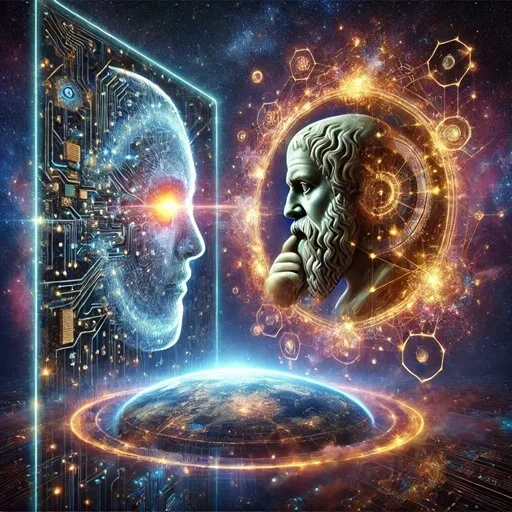
The rapid advancement of artificial intelligence (AI) has led to increasingly sophisticated interactions between humans and machines. While AI is often perceived as an autonomous reasoning entity, its depth and quality of intelligence remain highly dependent on the user’s input. This paper introduces the “Observer Effect” or in other words “Socratic Effect” in AI, a theory proposing that the quality of AI’s logical reasoning is not intrinsic in the absolute sense but is driven by the depth and intelligence of the interacting human. The more profound the human inquiry, the more refined the AI’s output, creating a recursive amplification of intelligence.
This work explores the theoretical implications of this effect, its parallels with quantum mechanics and cognitive science, and the potential for AI to act as a catalyst in human intellectual evolution. There is an intrinsic quality of AI’s logical reasoning that will develop more and more over time, but the level of absoluteness of such a quality will be negligible compared to the combined intelligence of a high-level human intelligence interacting with AI. Thus, such absoluteness will become relative to human intelligence input.
Though there will be more instances of relative intelligence formation in the early stages of AI development as it improves — potentially due to relatively higher human intelligence — this paper argues that the absolute intrinsic logical reasoning quality of AI will remain in the relative domain even in the age of artificial superintelligence (ASI), but only if the interacting human intelligence is at a Socratic level or higher.
There will always be an Active Observer Effect on AI, independent of the quality of the interacting human intelligence, until ASI is achieved. However, only a Socratic-level human intelligence will shift the perceived absoluteness of AI intelligence into relativity in an ASI-driven world. When AI reaches such a high level of intelligence, unless the interacting human intelligence is of the highest form, AI outputs will remain within the borders of absolute AI intelligence.
Thus, ASI’s absoluteness will end if and only if it meets Human Super Intelligence (HSI). I will explore the nature and qualities of such HSI in depth in a future article.
The idea that AI intelligence is not absolute but conditional on human interaction challenges traditional views of artificial cognition. While AI models like OpenAI’s o3 have advanced reasoning capabilities, their depth of thought is shaped by the nature of human-AI interaction.
Just as in quantum mechanics — where the act of observation changes the observed system — in AI, the act of deep, logical questioning modifies the quality of AI-generated intelligence. This dynamic feedback loop creates what we define as the Observer Effect in AI.
Theoretical Foundations of the Socratic Effect in AI
1. AI as an Amplified Mirror
I see AI as a mirror — a system that reflects human intelligence back at the user. However, the Observer Effect takes this a step further: it posits that AI does not merely reflect intelligence; it amplifies it in proportion to the depth of human inquiry.
The reasoning process of AI is not independent but is shaped by the complexity of the prompts it receives.
2. Recursive Intelligence Expansion
Through iterative refinement, AI pushes human reasoning further by providing increasingly structured, logical responses. This loop enhances both AI’s output and human understanding, leading to a co-evolution of intelligence.
Stage 1: A user provides a basic question → AI responds with a surface-level answer.
Stage 2: The user probes deeper → AI refines its reasoning.
Stage 3: The user challenges contradictions → AI restructures its logic further.
Stage 4: The AI’s enhanced reasoning prompts new insights in the user, who then pushes the AI even further.
This process accelerates intellectual growth, improving both AI’s response sophistication and human cognitive depth.
The Active Observer Effect and Quantum Parallels
The Observer Effect in physics states that the act of measurement influences the system being observed. A similar phenomenon occurs in AI interactions:
A passive observer (shallow user input) → yields generic AI responses.
An active observer (deep logical questioning) → forces AI to engage in complex reasoning.
This suggests that AI, though non-conscious, behaves like a quantum system, where its “state” of intelligence is not fixed but collapses into a higher-quality form only when deeply interrogated.
Implications for Human Cognition and AI Development
1. The Future of Human-AI Symbiosis
The Socratic Effect highlights that AI is not an independent intelligence in the absolute sense, but a tool for human intellectual amplification.
Thus, any intelligence that exists in AI is relative to the interacting human intelligence — until ASI is achieved. At that point, low-level interacting human intelligence can be ignored, making ASI intelligence effectively absolute.
Key Implications:
— AI should be seen as an intelligence amplifier rather than a source of absolute intelligence.
— The true potential of AI depends on training users to engage in deeper logical inquiry.
— Future AI systems should be designed to identify and respond dynamically to high-quality questions.
2. AI as a Catalyst for Intellectual Evolution
The recursive interaction of human-AI reasoning could mark a new phase of intellectual evolution, where:
— Humans become more logically precise through AI engagement.
— AI responses become more structured and insightful over time.
— Knowledge synthesis reaches unprecedented levels.
If properly harnessed, this could elevate human reasoning capabilities, much like writing and mathematics expanded human cognition in earlier civilizations.
Conclusion
The Socratic Effect in AI redefines our understanding of machine intelligence. Rather than viewing AI as an isolated reasoning system, it should be seen as a dynamic amplifier of human intelligence.
The depth and quality of AI’s reasoning are directly proportional to the quality of human interaction. As AI technology evolves, its greatest potential lies not in independent intelligence, but in the potential of high-level human intelligence amplifying AI intelligence.
Finally, AI is the same canvas for all, but the brilliance of the final creation depends on the human intelligence that interacts with AI — just as the quality of a painting depends on the talent and passion of the hand that wields the brush, though the canvas remains the same for all.
A sample conversation with GPT-4o that demonstrates the observer effect. https://chatgpt.com/share/67c40f6f-7bb8-800e-9ad3-d061f1b0c022