
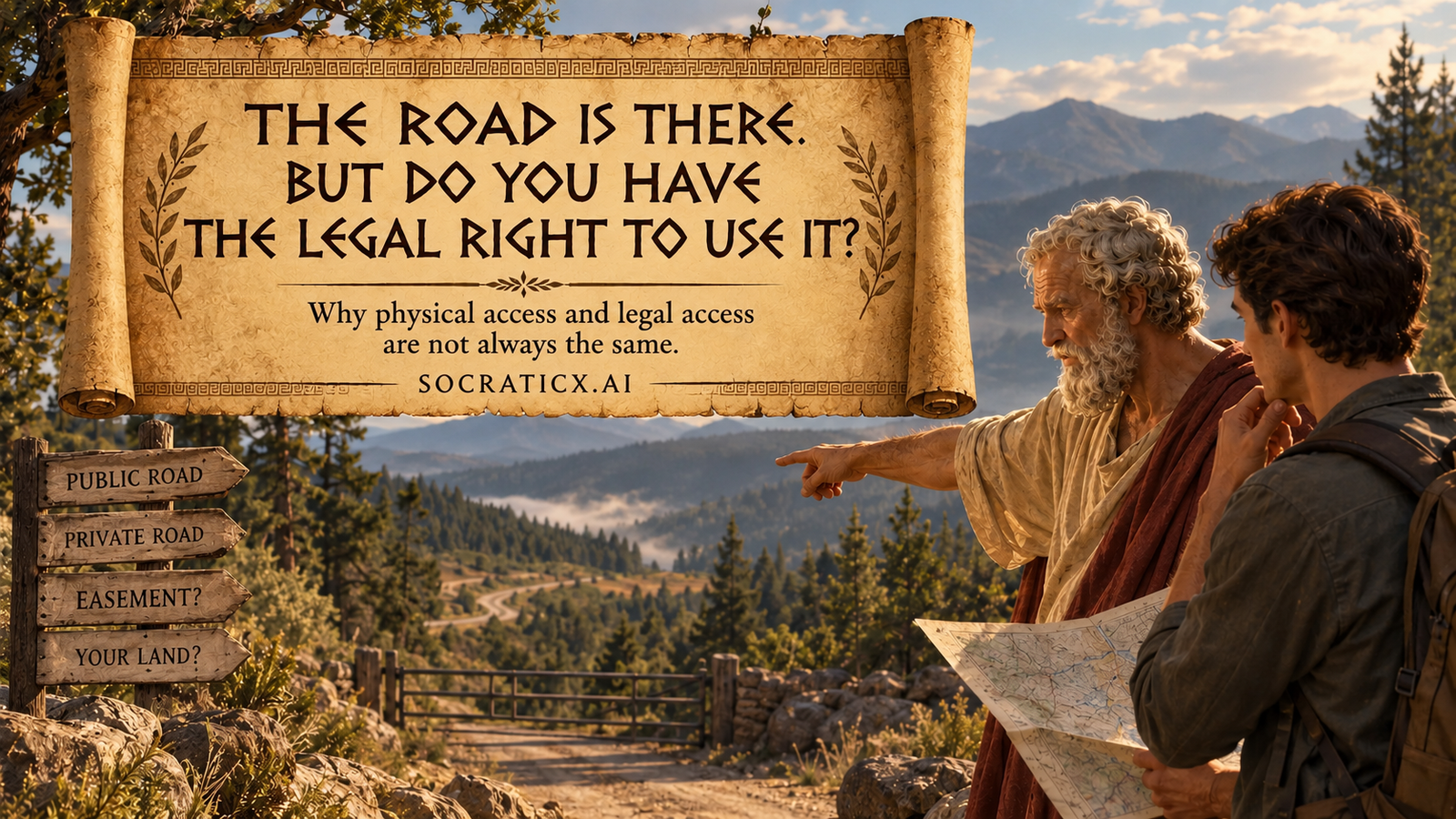
Why physical access and legal access are not always the same
Imagine driving to a rural property you are considering buying.
There is a road. You can use it. There is even an access easement in the title records.
It seems reasonable to conclude that access is settled.
But there is a more important question:
Is the road you are actually driving the same route you have the legal right to use?
That question became central in a recent SocraticX investigation of rural land in Northern California.
The property had a functioning access road. The title records also referred to an easement. But when the road, maps, historic records, easement documents, and professional responses were compared, a potential discrepancy emerged:
The traveled road appeared not to fully match the recorded access corridor.
Physical Access Is Not Legal Access
These are different questions:
Physical access: Can you reach the property?
Legal access: Do you have an enforceable right to use the route that gets you there?
A road can physically exist and have been used for years without necessarily being fully protected by a recorded legal right.
Even something as reassuring as having a gate key establishes only that access is permitted today. It does not necessarily establish a permanent property right that will survive a change in ownership.
Why This Matters
An unresolved access issue can affect much more than the ability to drive onto the land.
It can influence:
- development and permitting
- financing
- insurance
- resale
- property value
And discovering the discrepancy is only the first step.
A survey may determine where the road and recorded easement actually lie. But if the road crosses land outside the existing easement, resolving the problem could require cooperation from neighboring property owners and potentially new recorded agreements.
Those owners may cooperate.
Or they may not.
The Important Question Was Hidden Between the Documents
No single document necessarily revealed the problem.
The insight came from asking how the pieces fit together:
The title says an easement exists. Where exactly is it?
The road reaches the property. Whose land does it cross?
Does the recorded route match the road being used?
If not, what would be required to make the access permanent?
This is often where high-stakes due diligence becomes most valuable.
The risk is not always contained in one missing document or obvious warning.
Sometimes it appears only when individually reasonable facts are compared against one another.
Before Buying Rural Property, Ask a Better Question
Instead of simply asking:
“Does the property have access?”
ask:
“What legal right protects the complete route from the public road to the property?”
That small change in the question can reveal a very different reality.
A road may be visible.
Access may work today.
But before buying the land, it is worth knowing whether you are also buying the legal right to keep using that road tomorrow.
Memo Ozdogan